Everything You Need to Know About Zoning Regulations in France

1. Filing the Authorization
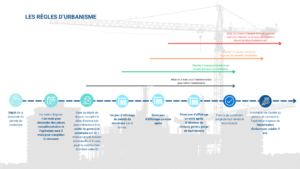
Each permit must be submitted, with a receipt issued, to the town hall of the municipality where the project is being carried out. From that point on, the town hall has 30 days to request additional documentation, such as plans, certificates, etc. The operator then has three months to complete the application and submit a full set of documents.
Receipt of the complete application marks the start of the review process, and the processing time may vary depending on the type of authorization:
- 1 month for a Preliminary Declaration
- 2 months to obtain a building permit for a single-family home
- 3 months for other building permits and development permits
In addition to these standard time limits, there are cases in which the investigation period may be extended. This allows the investigating agency to adapt to specific circumstances that may, for example, require consultation with external agencies.
Thus, in a protected area, at a site of special interest, or in the vicinity of a building listed as a historic monument, the standard review period is extended by one month to allow for consultation with the Architecte des Bâtiments de France. Another example: if the project involves the development of a facility open to the public, the review period is extended to 5 months.
At the end of this period, the city hall issues a building permit order or a notice of no objection to a prior declaration.
If no response is received within the legal time limit (1, 2, or 3 months), the permit is deemed to have been granted by implication. This is because the city hall is required to respond. Subsequently, upon simple request to the city hall, it is possible to obtain the certificate of implied approval confirming that the permit has been granted.
2- Revocation of the Authorization
After obtaining the order authorizing the work, the operator must then ensure that the authorization is not subject to an appeal by a third party or administrative revocation.
- Third-party appeals: A person with a stake in the matter—typically a neighbor—may object to the real estate project. The deadline for filing an appeal is two months from the datethe first notice of approval is posted on the property or building.
During the notice period, a bailiff is appointed to verify, through three official reports, that the sign remains posted. The sign must include the mandatory information listed below:
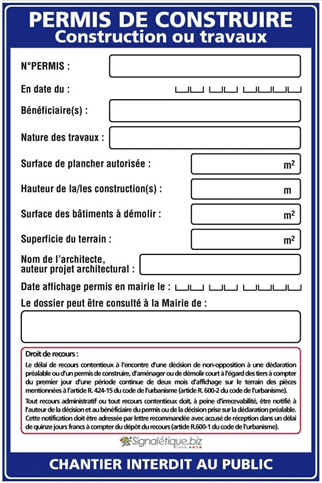
If any of the required information is missing, even after a two-month public notice period, the building permit will not be considered approved.
If the planning permits have not been revoked, or if it cannot be proven that the notice was displayed continuously, any person with a legal interest may file an appeal up to 6 months after the completion of the work.
- Administrative revocation: carried out by the government, it may occur within 3 months of the date the license was issued. It applies if the initial decision is found to be unlawful.
To clarify: when the mayor grants a planning permit, he forwards the complete file to the prefect so that the prefect can verify its legality. If any illegality is found, the prefect may ask the mayor to revoke the permit. However, the mayor may also do so on his own initiative if he becomes aware of the illegality. To do so, the mayor issues a revocation order that nullifies the permit originally granted, which is then considered to have never existed.
As for the grounds for illegality, these include failure to consult a committee specific to the type of project, failure to hire an architect (for the construction of a building larger than 150 m²), failure to comply with zoning regulations, etc.
3- Proof of purging
To justify the absence of an appeal or administrative revocation, the operator will turn to both the municipality and the administrative court with jurisdiction over the municipality where the project is located.
City Hall issues certificates of non-appeal and non-withdrawal. Depending on the case, the certificate may indicate no incident, a withdrawal, or a so-called “informal” appeal. A certificate of non-withdrawal can only be issued by City Hall. This is because only the administrative authority that made the decision in question is authorized to have withdrawn it and to provide information on the matter.
A Closer Look at Administrative Appeals
Any person with an interest in the matter may file an administrative appeal; this simply involves submitting a request to city hall asking it to reverse its decision. City hall then has two-month period to respond; otherwise, its silence will constitute an implied rejection of the request. Beginning with the notification of refusal or the implied rejection, a new 2-month period begins during which the petitioner may file a judicial appeal (the case is referred to the administrative court).
The administrative court, for its part, issues a certificate of non-litigation. In most cases, this certificate is requested directly at the end of the period during which the sign is posted on the property. Indeed, it is possible for a litigious appeal to be filed without going through the administrative appeal phase. This is why the operator must submit a request for a certificate of no legal action to both the city hall (administrative appeal) and the administrative court (legal action).
If an informal appeal has been filed, it is essential to request a certificate of non-appeal from the administrative court once the aforementioned informal appeal periods have expired—that is, 2 months from the date the city hall rejected the request for annulment or 2 months from the date of the city hall’s implied rejection (failure to respond). This allows you to verify whether the informal appeal has been definitively withdrawn.
A Closer Look at Litigation
If an application to revoke a zoning permit is filed with the administrative court, a ruling will be issued either granting or denying the appeal. If the appeal is denied, the petitioner has another 2 months to file an appeal with the Court of Appeals. If that appeal is denied, the petitioner has yet another 2 months to file an appeal with the Council of State.
The petitioner may terminate the proceedings at any time, either on his or her own initiative or as a result of a settlement agreement in which an amicable agreement is reached between the operator and the petitioner.
Conclusion
In conclusion, it is very important for every developer to thoroughly research the process in advance to avoid any setbacks in the implementation of their real estate project. The cumulative time required for legal procedures (review, appeals, etc.) can take several months; this is why financing companies, such as Raizers, do not become involved until all permits have been finalized and all appeals have been resolved.
Operators must also verify the validity of administrative authorizations, which have a limited duration.